
A printer in Bletchley quotes you £120 for 5,000 leaflets. That sounds cheap. Then the delivery quote lands, someone mentions design, and you start to wonder what you will actually get back.
This guide puts real numbers on a leaflet drop in Milton Keynes. You'll see what each part costs, what response to expect, and how many leaflets it takes to win one customer.
Get Found, Get Chosen, Get Your Time Back
A free one-day marketing seminar in Milton Keynes · 13 January 2027
We'll also show you how to track it. Most owners never find out if their leaflets worked, because nobody set up a way to count the calls, the visits or the people who walked in holding one. That's the part we want to fix.
Get your free Marketing Action PlanNot sure where to start? Answer a few questions and get your plan in about a minute. No email needed.
Get my plan →How Much Does A Leaflet Drop Cost In Milton Keynes?
A leaflet drop to 5,000 homes in Milton Keynes typically costs £400 to £900 all in, as of November 2026. That covers design, printing and solus delivery, or about 8p to 18p per door. Shared delivery cuts the bill by about a third, and doing it yourself costs time instead of money.
Here's how that splits for a typical A5 leaflet, printed on both sides. These are the quotes we see for local clients right now, so treat them as a guide and get three quotes of your own.
- Design: £0 if you do it yourself, £100 to £250 for a freelance designer.
- Printing: £90 to £180 for 5,000 A5 leaflets on decent paper.
- Solus delivery: £60 to £90 per 1,000 doors, so £300 to £450 for 5,000.
- Shared delivery: £35 to £55 per 1,000 doors, so £175 to £275 for 5,000.
- Tracking: £0 to £10 a month for a call tracking number.
The printing is the cheap bit. Delivery is where most of your money goes, and it is also where most of the quality sits.
A cheap print job still gets read, but a cheap delivery job might never reach a letterbox at all, and you'll have no easy way of knowing it didn't.
What Is A Leaflet Drop, And What Are You Paying For?
A leaflet drop is a printed advert pushed through letterboxes in an area you choose. You pay for three things: the design, the print run and the people who walk the streets. The walking is the expensive part.
There are four ways to get leaflets through doors. Each one changes the price and the result.
Solus delivery means your leaflet goes through the door on its own. Nobody else's menu or flyer is wrapped round it.
It costs more, but your leaflet gets the full attention of whoever picks it up off the mat, and that attention is exactly what you're paying the extra few pounds for.
Shared delivery means your leaflet goes in with three or four others. It's cheaper because the distributor splits the walking cost.
The catch is that yours lands next to a pizza menu and a window cleaner's flyer. It happens a lot.
Royal Mail Door to Door sends your leaflet out with the normal post. Your postie delivers it on their round.
As of November 2026, Royal Mail's pricing page says around £500 delivers about 8,160 leaflets, which works out at roughly 6p each.
Doing it yourself costs nothing but your time. One estimate on UK Business Forums puts it at about six hours to deliver 1,000 leaflets.
That is 30 hours of walking for a 5,000 drop. Bring good shoes.
Milton Keynes adds its own twist. The grid roads split the city into estates, so routes don't follow the usual high street pattern.
Walking from one estate to the next on the redways takes longer than you'd think, so ask any distributor how well they know the city before you hand them your leaflets.
Are Leaflet Drops Still Worth It In 2026?
Yes, for the right business. A leaflet drop works when you serve a tight local area, sell something people buy again, and can make an offer worth keeping. It works badly for businesses that sell to other businesses or cover the whole country.
Think about who reads a leaflet. It's someone standing in their hallway, holding a piece of paper about a service near their house.
That's a very local, very physical moment. Google can't give you that.
The businesses that do well with leaflets tend to look alike. They are takeaways, cleaners, gardeners, dog groomers, driveway firms, tutors and local trades.
Their customers live within a few miles of the van or the shop, they often need the service more than once, and they like using someone nearby.
The maths favours repeat customers. A window cleaner who wins one household at £20 a month earns £240 a year from it. Three new customers pay for a whole 5,000 drop.
A one-off sale needs a bigger ticket. A kitchen fitter might only need one job from 10,000 leaflets to come out well ahead.
A £15 car wash needs dozens of new customers to break even. That's a hard ask.
There's one more reason it still works. Fewer businesses use leaflets than ten years ago, so letterboxes are quieter and a well-made leaflet has a better chance of being read than it did when every takeaway in town posted one weekly.
Milton Keynes is also growing fast. The ONS says its population grew by 15.3% between 2011 and 2021, to around 287,000 people.
New estates mean new households. New households need a plumber, a cleaner and a takeaway they trust. A leaflet is often the first local name they see.
The Real Bill For 5,000 Leaflets
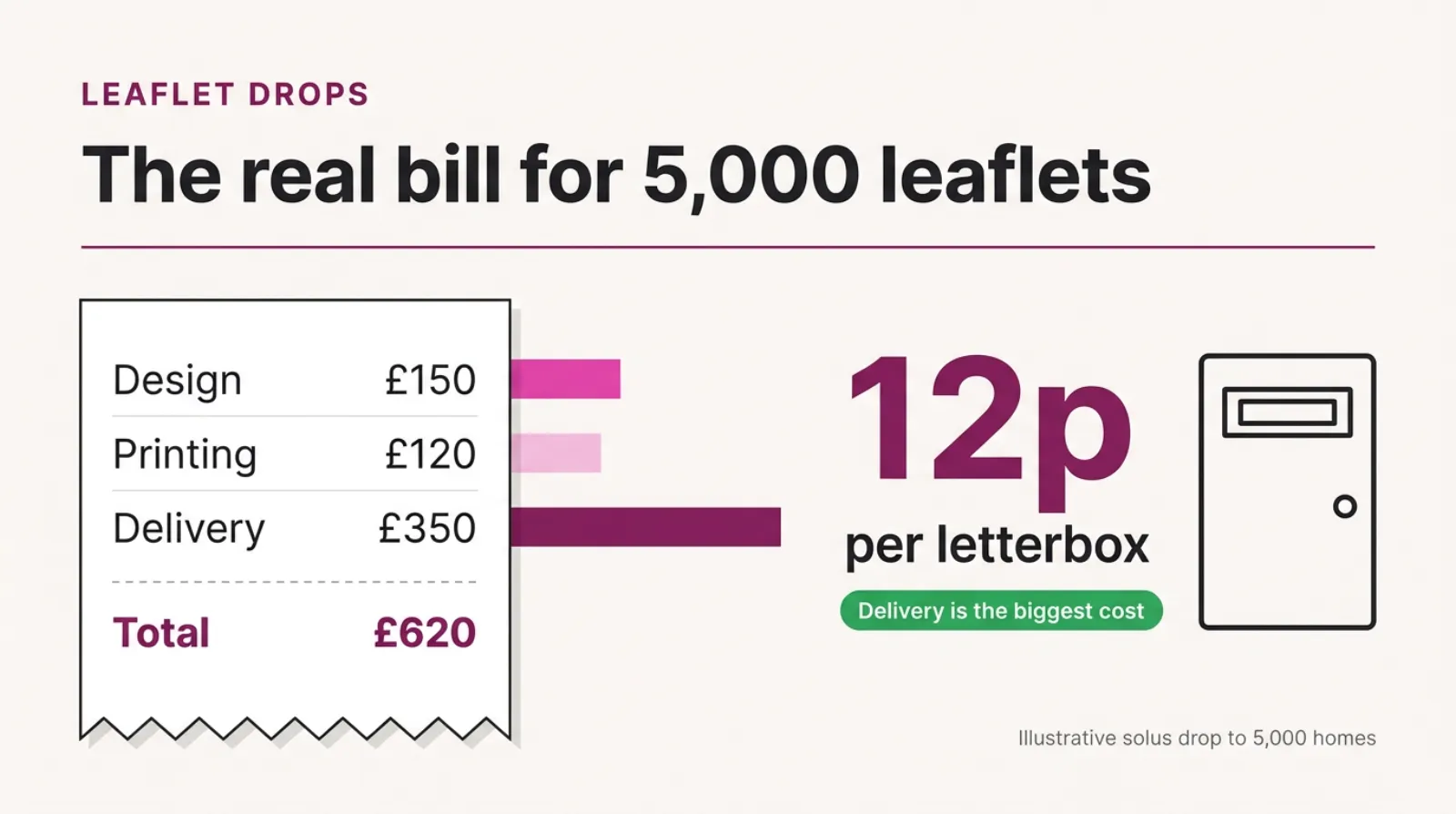
Our worked example is a solus drop to 5,000 homes. A freelancer designs it for £150, printing costs £120, and delivery at £70 per 1,000 adds £350.
The total is £620, or about 12p per door. That's the number.
Hold on to that 12p figure. Everything else in this guide comes back to it. Write it down.
Solus, Shared Or Royal Mail: Which Delivery Should You Pay For?
Pick solus delivery if you want the best response and can pick your streets. Pick Royal Mail if you want reliable delivery at a low price per door. Pick shared delivery only if your budget is tight and your offer is strong enough to stand out in a pile.
Here's how the four options compare for a 5,000 drop in Milton Keynes.
| Solus | Shared | Royal Mail Door to Door | Do it yourself | |
|---|---|---|---|---|
| Rough delivery cost for 5,000 | £300 to £450 | £175 to £275 | Around £310 | £0, plus about 30 hours |
| Your leaflet arrives | On its own | With 3 or 4 others | With the post | On its own |
| Choose your own streets | Yes | Usually by area | By postcode sector | Yes |
| Proof it was delivered | GPS tracking from good firms | GPS from some firms | Royal Mail's own process | You know it was |
| Best for | Strong offers in a set patch | Very low budgets | Wide reach, steady quality | Starting out, small areas |
The Royal Mail figure is based on the pricing page quote of about 6p per item. Their prices change with leaflet weight and size, and they do not include VAT.
So check the current rate card before you plan around it. Prices move every year.
Ask every distributor about GPS tracking. A good firm can show you the route each walker took.
A cheap firm that can't show you that is asking you to trust them with your money, and you'll only find out they let you down when the phone stays quiet.
Here's a quick test we use with clients. Ask the distributor for a map of last week's routes in your area. If they hesitate, find another firm.
Don't forget flats. Central Milton Keynes and Campbell Park have lots of apartment blocks with fob entry.
Walkers often can't get in, so your leaflets end up in a bin by the door or do not get delivered at all.
What Is The Average Response Rate For A Leaflet Drop?
Most UK leaflet drops get a response rate of between 0.5% and 2%. The DMA's guide puts the average at around 1%. A response means a call, a visit, a message or an offer code used, not a sale.
That range matters more than the average. A well-targeted drop with a strong offer can beat 2%. A shared drop with a vague message can come in under 0.2%.
Here's what changes the number most, in rough order.
- The offer. A clear reason to act now beats a list of services every time.
- The area. Homes that need what you sell respond far better than random streets.
- Repetition. The second and third drop to the same streets usually do better than the first.
- Delivery quality. Solus beats shared, and a leaflet in a bin beats nothing.
- The design. Clean and readable beats busy and clever.
Notice that design comes last. That surprises people. Owners spend weeks on the design and minutes on the offer. It should be the other way round.
How Many Leaflets Do You Need To Deliver To Win One Customer?
Most local businesses need 500 to 2,000 leaflets to win one paying customer. At a 1% response, 5,000 leaflets bring about 50 responses. If one in three becomes a sale, that's 15 or 16 customers from one drop.
Now run your own numbers. You only need three figures: your cost per door, your response rate and how many responses turn into sales.
Here's the sum, using our £620 example.
- 5,000 doors at a 1% response gives 50 responses.
- If a third of those buy, you get about 16 customers.
- £620 divided by 16 is about £39 per customer.
That's your cost per customer. Now compare it with what one customer is worth to you over a year.
If a customer is worth £240, paying £39 to win one is a good deal. If a customer is worth £30, it's not. Same leaflet, same city, very different answer.
Be honest with yourself here. Plan for the worst. Use a 0.5% response for your first drop, not 2%. If the numbers still work at the low end, you're on solid ground.
Three Worked Examples: A Cleaner, A Takeaway And A Kitchen Fitter
These three examples use the same £620 drop to 5,000 homes. They're illustrations built from typical prices, not real client results. They show why the same leaflet can be a great deal for one business and a waste for another.
The domestic cleaner. A regular clean is worth about £60 a fortnight, or around £1,500 a year.
At a 0.5% response, the drop brings 25 enquiries. If five become regular customers, the leaflet earns back its cost many times over in the first year.
The takeaway. An average order is about £25, and the margin on it is thin.
At a 1.5% response, the drop brings 75 first orders. The leaflet only pays if a good share of those people order again, so the offer should push a second visit.
The kitchen fitter. One kitchen might be worth £8,000 or more.
Response will be low, maybe 0.2%, because few people need a kitchen this month. Ten enquiries and one sale still turns £620 into a very good return.
The pattern is simple. The higher the value of a customer, the lower the response you can live with. Work out your own number before you print anything.
What Makes A Leaflet Pay For Itself?
A leaflet pays for itself when the customers it wins are worth more than the drop cost. That depends far more on what you sell than on the leaflet. Repeat work, local demand and an offer people keep are what tip the balance.
Here are the levers that move a leaflet from loss to profit.
Pick streets that need you. A driveway firm should target older semis with block paving, not new-build flats. A tutor should target family estates near primary schools.
Make an offer with a deadline. "10% off your first clean if you book by 30 November" gives people a reason to call this week.
"Quality cleaning at fair prices" gives them a reason to recycle it. Most people do.
Drop the same streets more than once. People rarely act on the first leaflet. They act on the third one, when the timing finally suits them.
Make it easy to respond. A big phone number, a short web address and a QR code. Nobody wants to search for how to reach you.
 LIVE
Live every Tuesday at 2pm UK. Bring your marketing questions.
Get your Google, local SEO and AI questions answered live.
Follow up the people who call. A missed call from a leaflet is lost money. Answer the phone, or call back within the hour.
From 5,000 Doors To 16 Customers
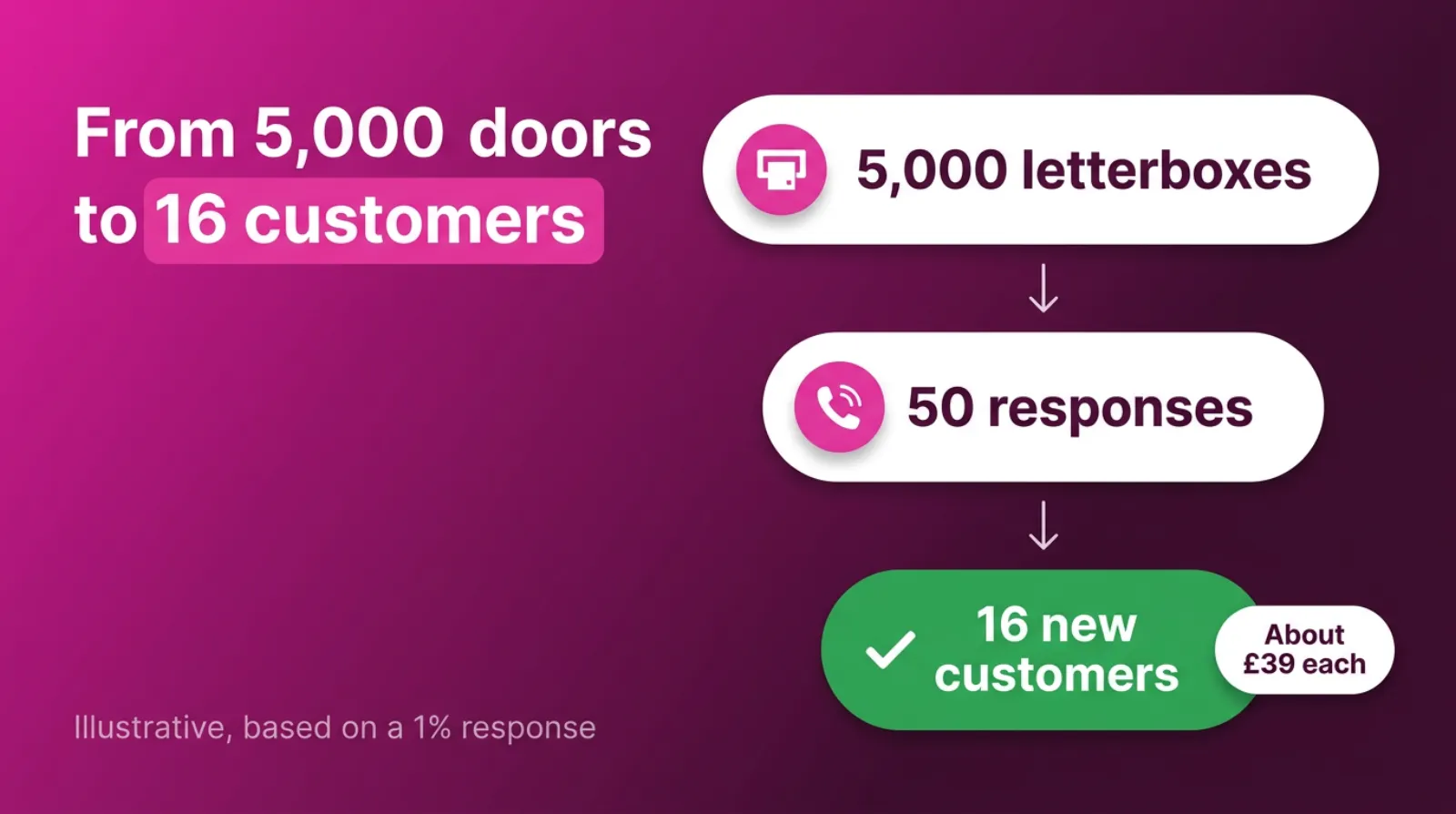
This is the honest shape of a leaflet drop. Most leaflets go in the recycling. Expect it, because that's normal. The few that stick are the ones that pay for the rest.
Which Parts Of Milton Keynes Should You Leaflet First?
Start with the estates closest to you and full of the homes that need your service. In Milton Keynes that often means picking whole estates, not postcodes, because the grid roads split the city into neat blocks. Small, tight patches you can drop three times beat one big drop across the city.
Milton Keynes is easier to plan than most towns. Each grid square is its own estate, with one or two roads in and out.
That makes it simple to draw a clean delivery area on a map, hand it to the distributor and check afterwards that every street inside it was covered.
Think about the type of housing too. Newer estates on the edges of the city have lots of first-time owners.
They need trades, cleaners and gardeners, and they don't have a list of names yet.
Older areas like Bletchley and Wolverton have more long-term residents. They often have a trader they already use, someone who did the boiler or the fence ten years ago and has been their first call ever since. You'll need a sharper offer to win them over.
The market towns are different again. Stony Stratford, Newport Pagnell and Olney have strong local loyalty. A leaflet that mentions the town by name usually does better than a generic one.
There are around 113,000 households in Milton Keynes, according to the 2021 Census. You do not need to reach all of them.
You need to reach the 5,000 most likely to buy from you, three times.
What Should Go On A Leaflet So People Actually Call?
A leaflet that gets calls has one clear offer, one reason to act now, and one easy way to respond. Everything else is decoration. If someone can't tell what you sell and why they should call within three seconds, it's too busy.
Here's the layout we suggest to local clients.
- A headline that names the problem. "Garden out of control?" works better than your company name.
- One offer with a date. A free quote by a set date, money off a first visit, or a free extra.
- Two or three lines of proof. A review, a star rating or "trusted by 200 families in MK".
- A big phone number and a short web address.
- A QR code that goes to a page made for this leaflet.
Put your Google rating on it. People in Milton Keynes will look you up before they call, so make sure what they find matches what the leaflet promised.
Keep the back simple. A short list of services and a photo of real work is plenty. Don't fill every gap with text. White space helps.
How Do You Track Whether A Leaflet Drop Worked?
Give the leaflet its own phone number, its own web page and its own offer code. Then count every call, visit and code used for six weeks after the drop. Without tracking, you will never know if your £620 brought in £3,000 or nothing.
Most owners skip this step entirely. It's a mistake. Then they say leaflets don't work, when really they just don't know.
Here's the simple version.
- A call tracking number costs about £5 to £10 a month and logs every call from the leaflet.
- A QR code that points to a page only the leaflet uses shows you how many people scanned it.
- An offer code like MK10 tells you which sales came from the drop.
- Asking "how did you hear about us?" on every call fills in the gaps.
Put a tracking tag on the web address in your QR code. Then Google Analytics shows you visits from the leaflet as their own group.
If you are not sure how to set that up, a good agency can do it in an hour, and it's worth doing before the leaflets go to print rather than after.
Write your results down in a simple sheet. Date of drop, streets, number delivered, calls, visits, codes used and sales.
After two or three drops, you'll know your real response rate in Milton Keynes. No guide can give you that.
Why Did My Leaflet Drop Get No Response?
When a leaflet drop gets no response, the cause is usually one of four things. The leaflets weren't delivered, the offer was weak, the area was wrong, or you only dropped once. Tracking tells you which one it was.
Delivery failure is more common than people think. Ask any distributor. Cheap distributors sometimes dump bundles in a skip. Ask for GPS proof, and ask a friend on the route if theirs arrived.
A weak offer is the next most common cause. "Professional, reliable, affordable" doesn't give anyone a reason to call today. A specific offer with a deadline does.
The wrong area is easy to fix. If you sell garden care, skip the flats. If you sell to families, skip the streets full of retired couples.
Dropping once is the quiet killer. One drop is a test, not a campaign. Most people need to see your name a few times before they trust it enough to call.
Who Should Skip A Leaflet Drop?
Skip leaflets if your customers aren't local, if you sell mostly to other businesses, or if one customer is worth less than about £30 to you. In those cases the maths rarely works, however good the leaflet looks.
Online shops are the clearest example. They rarely benefit. Your buyers could be anywhere in the UK, so paying to reach 5,000 doors in one city makes little sense.
Very busy businesses should skip it too. If you're already turning work away, a leaflet just creates enquiries you cannot serve. That hurts your name more than it helps.
And if you can't track it, wait until you can. A drop you can't measure teaches you nothing, so you'll be guessing again next time.
A Six-Week Leaflet Plan For A Milton Keynes Business
Here's the plan we'd give a local business starting from scratch. It keeps the first spend small and gives you real numbers fast.
- Week 1: Pick 2,000 homes in one or two estates that clearly need what you sell.
- Week 1: Write one offer with a deadline and set up your tracking number, QR page and code.
- Week 2: Print 6,000 leaflets so you've got enough for three drops of the same streets.
- Week 2: Book solus delivery with a firm that offers GPS tracking.
- Week 3: Send the first drop out midweek, so it lands before people plan their weekend.
- Week 5: Send the second drop to the same homes.
- Week 7: Send the third drop, then count everything two weeks later.
Printing and solus delivery for that plan come to roughly £470 to £760, plus design if you don't already have a leaflet. It's small enough to test without risk and big enough to give you a real response rate.
If the numbers work, double the area. If they don't, change one thing and test again. Change the offer first, because it's the cheapest thing to fix.
How Does A Leaflet Drop Compare With Google Ads?
A leaflet drop reaches people who weren't looking for you yet. Google Ads reaches people who are searching right now. Leaflets are usually cheaper per person reached, while Google Ads usually costs less per enquiry for urgent jobs like a boiler repair.
Think of it as timing. Someone with a burst pipe won't wait for a leaflet. They'll search on their phone and call the first plumber who looks trustworthy.
Someone who has been meaning to get the gutters cleaned since last autumn is different, because the job matters to them but it never feels urgent enough to search for today. They aren't searching. A leaflet on the doormat is what reminds them to finally sort it out.
So the right choice depends on how your customers buy. Urgent, need-it-today services suit Google Ads. Planned, can-wait services often suit leaflets. Many local businesses do best with a little of both.
The fair way to compare is cost per customer. If leaflets win customers at £39 each and Google Ads wins them at £60, leaflets win.
If it is the other way round, move the money. Track both properly and the decision makes itself. Numbers settle it.
Leaflets Work Better With Google Behind Them
A leaflet starts a search more often than it starts a call. People see your name, then check you out on their phone. If they can't find you, or your reviews look thin, the leaflet did half its job.
So before you print, check three things. Search your business name and see what comes up. Check your Google Business Profile is complete. Make sure you've got recent reviews.
We often run a small Google Ads campaign on a client's brand name during a leaflet drop. It costs a few pounds a day.
It means anyone who searches your name after reading the leaflet finds you first, not a competitor who happens to be bidding on your name that week.
This is where print and digital stop being rivals. The leaflet makes people aware of you. Google closes the deal.
Frequently asked questions
Is it legal to put leaflets through doors in the UK?
Yes, posting leaflets through letterboxes is legal in the UK. Respect "no junk mail" signs, though, because ignoring them annoys the very people you want as customers.
Handing leaflets out in the street is different. Councils can control that in certain areas under the Environmental Protection Act 1990.
How often should I do a leaflet drop?
For most local businesses, every two to four weeks to the same streets works well for a first campaign. Three drops in two months is a good test.
After that, many businesses settle into one drop a month or one per season, depending on how full the diary is and how quickly the response tails off.
Is it better to deliver leaflets myself?
Delivering them yourself saves money but costs a lot of time. At around six hours per 1,000 leaflets, a 5,000 drop takes most of a working week.
It makes sense for a very small patch. For anything bigger, your time is usually worth more than the delivery fee.
What size leaflet works best?
A5 is the most popular size for a leaflet drop because it's cheap to print and easy to read. A6 costs less but gives you less room for the offer.
DL, the size of a long envelope, works well for menus and price lists.
When is the best time of year for a leaflet drop?
It depends on what you sell. Gardeners do well in early spring, heating engineers in early autumn, and takeaways almost all year.
Avoid the week before Christmas and the middle of the summer holidays, when people are busy or away.
How much does it cost to print 5,000 leaflets?
Printing 5,000 A5 leaflets on both sides usually costs £90 to £180 in the UK as of November 2026. Thicker paper and special finishes push the price up.
Local printers in Milton Keynes often match online prices, save you the delivery wait and let you check a proof copy in your hand before the full run.
Does Royal Mail deliver leaflets?
Yes. Royal Mail Door to Door delivers unaddressed leaflets with the normal post, and you can choose areas by postcode sector.
Prices depend on the weight and size of the leaflet. It's a good option if you want steady delivery quality across a wider area.
Do leaflet drops work for B2B businesses?
Not usually. Leaflets go to homes, and most business owners do not make buying decisions from their hallway.
If you sell to other businesses, networking, LinkedIn and Google Ads tend to work far better.
Keep Reading
If you're weighing up leaflets against other ways to reach local customers, these posts will help.
- The Five-Mile Test: Is Your Local Advertising Reaching Anyone Who Can Actually Buy?
- How Do I Promote My Business When I Have No Budget And A Van?
- How To Grow A Local Business That Only Serves One Town
- What Google Ads Costs A Local Business, In Real Numbers
- Your Customers In Milton Keynes Are Already Searching. Is Your Advertising There When They Do?
- Every Business Networking Group In Milton Keynes, With Dates, Prices And Who Turns Up
Each one looks at a different way to win local work, so you can compare the cost per customer side by side.
Sources
The population figures come from the Office for National Statistics, and the rules on handing out leaflets come from UK law.
- Milton Keynes population change, Census 2021
- Environmental Protection Act 1990, Schedule 3A
- The CAP Code, Non-broadcast Advertising
Every claim on a leaflet also has to follow the advertising rules in the CAP Code, so keep your offer honest.
Count Before You Print Again
A leaflet drop in Milton Keynes isn't a gamble if you treat it as a test. Spend a few hundred pounds, track every response, and you'll know your real cost per customer within two months.
Most owners never get that far. They print once, hear nothing for a fortnight, decide that leaflets don't work in Milton Keynes, and go back to hoping word of mouth will fill the diary. You now know how to do better.
Pick your streets, write one strong offer, and count everything. If you'd like a hand linking your leaflets to your Google presence, the team at SF Digital is happy to help.

Written by Uzair Kharawala
Partner at SF Digital Studios, a Google Premier Partner agency. Uzair has been helping businesses grow with Google Ads for almost 15 years and teaches it every week on YouTube.
Get our best Google Ads tips by email
New articles and videos, straight to your inbox. Unsubscribe any time.