Okay, I think we are live. I'm having some issues, so please bear with me, and I just want to make sure everything is working fine, and apologies for starting 10 minutes late. I'm still getting these black borders around the video, but anyhow, um, we will not let the technology beat us. We'll, we shall carry on. And it's very easy to quit, you know. Most, many people, they would just quit and not go live, or make excuses, or any excuse they need not to do certain things.
So I'm committing myself to these live streams twice a week, and I try my best to do them, and listen, until I'm away or some things which are out of my hands, um, I shall carry on doing this as long as you guys are listening to me and sending me questions and like the content which we put up. Okay, so I've got a couple of comments. So thank you Hernan, from, my friend from Argentina. Yes, um, I came second. Um, let me share this with you guys. Um, I was a bit disappointed, but at the same time very proud to have achieved something which, um, where is my screen?
Okay, here we go. So this is the Digital Marketer website, and I'm trying to get Scott in the photo, because I want to show him first of all. Okay, I'm gonna bring him in a little while. So we received over 4,000 words. Um, Alex, um, he won the competition, so many congratulations, very well deserved, and it was followed by myself and John Moran. John is the other half of Kasim at Solutions 8, and they also, we're great friends with them.
But the other good news was, um, Scott, I'm trying to bring him in here, uh, there you go. Um, Scott is a dear friend of mine. He runs a Merchant Mastery. He's got a e-commerce course, and if you're in e-commerce and you need help with growing your Shopify store, he's the man to, to go to. He is absolutely brilliant. So his agency got the Agency of the Year award. Um, so congratulations to Scott, Kirian, Simon, Dawson, Brandon, everybody, Odette, um, apologies if I haven't said your name, but yeah, the whole team at Merchant Mastery and Socialite, really well done to have won the Agency of the Year award.
Um, okay, so I have got quite a few things to go through today. I've got, I can see some of the comments coming in, so please do put them in now. If you're going to hold your question until the very end, I may not be able to reach, because it's impossible sometimes to go through each and every, but what I do do is go them in the order I receive in. So if you put them up now, at the start of the session, then yours would be at the top of the list. Otherwise you'll just carry on going at the bottom and I may not be able to address your question. So if you have your questions all, um, ready to fire, then put them up, you know, that's it, you're, you'll be in the queue then. You don't have to worry about it.
Okay, uh, so today I'm going to talk about targeting. Not many people talk about it, and also not many advertisers know how to set them up properly and campaigns. So this is used for, um, Display Network, video and so on. So I'm in my test account, um, so ignore all the messages which says ads not running or ads disapproved and so on. Okay, so now I have got a, let me bring this up. All right, so I'm gonna, a campaign, a display campaign set up over here, and here we go, in the, under content and the audiences. So these are the two tabs I'm going to focus on in this session today.
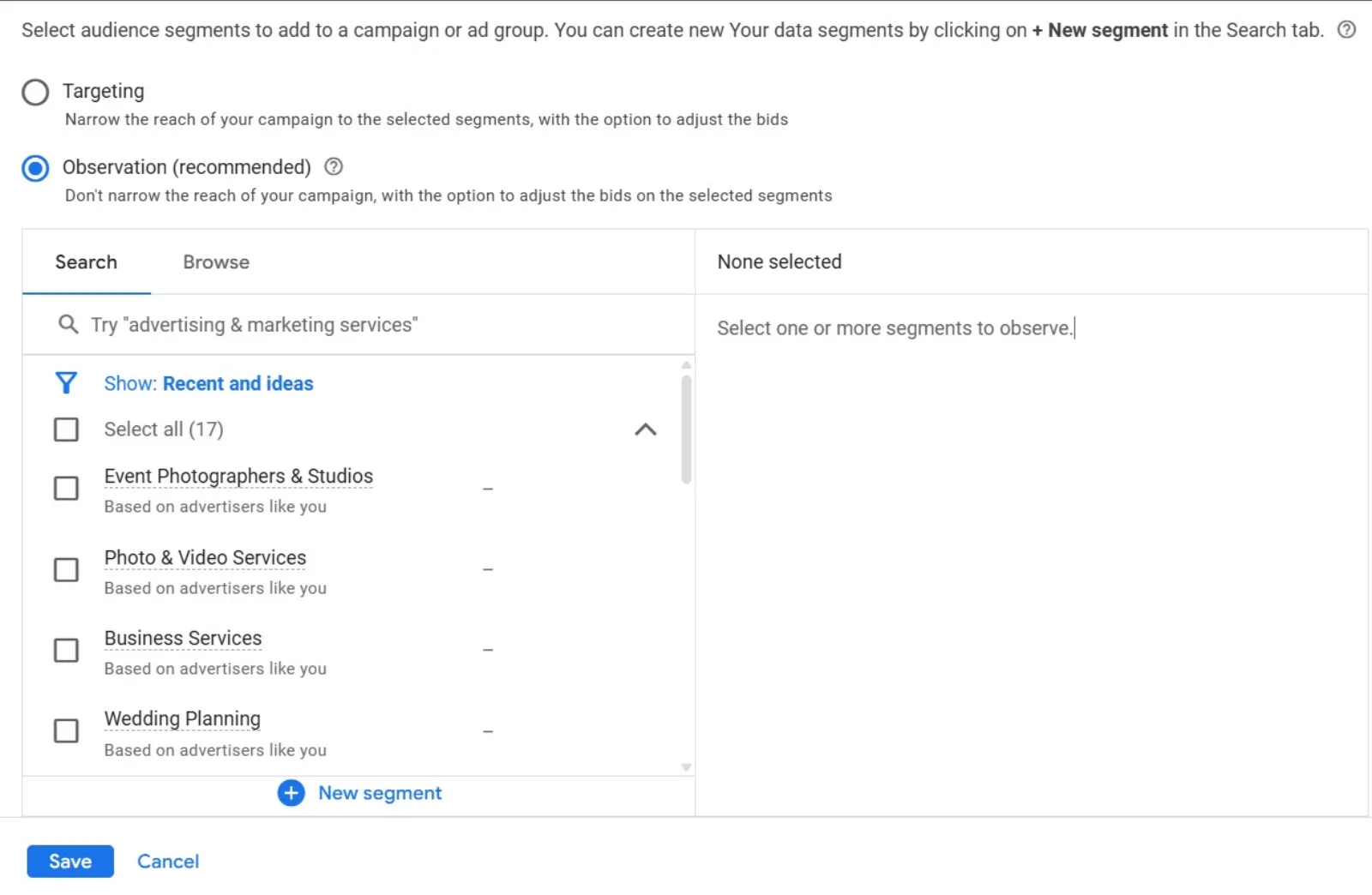
Let's go in audiences and see what we've got. So you go here. This keeps changing. Um, so we've got three sections over here. One is the audience segment, the other one is the demographic and the third one is the exclusions. Now if you want to add a segment of your audience to this, you go click add seg, audience segment, and then you need to select which ad group you want to set up, so I'm going to set up, select one. Then this is to, these are two options over here. One is the recommended, which is the targeting, and one is the observation. Again, a fair bit of confusion which pops up every now and then.
Observation, as the word suggests, is you are just observing. Nothing is going to happen, and it will not narrow down your, um, campaign or the targeting. So if you just want to see, if you target, let's say, an odd, particular audience, like we've got over here, CPC advertising, Sports and Fitness or whatever, you're just going to get data in your campaign or ad group or at whatever level, that these campaigns or these audiences are converting or not converting, and then you can target them. But targeting will narrow down, but then you are just targeting that. So if I were to select CPC advertising audience, it's going to target that. If I would select the observation button, it's just going to observe. It will not have any effect on how many I choose over here.
So you select this, right, and then you put them in your campaign. You have got this other tab here as well. So detailed demo, this again keeps changing. So many new ones pop up every now and then. Every time I come here there's something new. So now we've got single, in a relationship or married. Education, that's new, fairly new. Current university students: if you got a product or service for university students, then absolutely target those people. Home ownership, for realtors, estate agents, uh, people who are in that niche, you know, mortgages, people who are homeowners or renters, you can target those as well. Google knows everything and anything about us, so you can target those.
Affinity and in-market, again, a little bit of confusion happens. What is the difference between these two? Affinity is a long-term interest. So if I go to ESPN and check the football score or the cricket score or athletics or any sport, or cooking websites or movies or restaurants, Google knows I'm interested in this niche, that I'm interested in football. So that's a long-term interest, right? In-market is, as the word suggests, I'm in the market to buy something. So if I look for running shoes a few days ago on Google, Google knows our searching and surfing history, what we searched, what kind of sporting websites I'm going to to look at running shoes. Google is going to put me in this, uh, audience or category of in-market.
I'm in the market if I'm looking at car insurance or home loans or mortgages or getting married or whatever. I will be in multiple in-market audiences, right, because I can be getting married, I could be looking for a hotel room, I could be traveling, I could be looking for running shoes or restaurants or whatever. So I can be in various, same person, but in multiple categories of the in-market audience, right?
Uh, then we have the life events over here. This is again very interesting, and this keeps on, uh, changing, so always go in there every now and then to see what categories they have selected. So somebody is starting a business soon, or recently started the business, somebody's looking to change their jobs or starting a new job, marriage, moving, and you get the gist, right? You can select and then you can target them. Okay, then you've got other ones as well in there. I forgot to show you. Every time I go live, this Google Ads interface goes really slowly. Um, all right, browse, and then we have got the in-market, life audience I've done.
Then you got the your data and similar segments. So over here you can set up your data as well, upload to your list and set them up. I think over here it is custom segments. You can do that as well. You can create custom segments. So take about 10, 15 keywords about Google Ads or pay-per-click advertising or digital marketing, and then you set them up from under Tools and Settings, and then you set up a custom segment like this. So you can put in, let's say, digital marketing, right?
Um, you've got two choices here. Again, this was the old one, the in-market and affinity, which Google have, has removed now. People with any of these interest or purchase intentions: this is affinity, this one is in-market. They've just renamed it and rephrased it. Is the same thing. So I'll copy the name or the seed keyword, and then as you start to put in and type in more, is going to give you some drop down search term ideas. There you go: job description, specialist, course, the executives. If I want to include these kind of keywords in my targeting, I can do that.
Let's see. Now this is really good, if I wanted to run a course to all these people who's a strategist or a professional or a manager, prof, you know, this is amazing. Look, how to, if somebody is looking to how to become a digital marketing specialist, right in my alley, up my alley, all right, I can do that. Manage your skills, yes, somebody wants to increase their managerial skills for digital marketing, lead gen, management. All of these search terms I can target. Extremely powerful way, because these people have searched on Google. There's high intent.
This is what a lot of people and marketeers or business owners, when they are setting up these, or audiences or campaigns, they missed this mark, that, okay, what's the intent? And most people say, oh, Google Display Network is top of the funnel, it's for branding, YouTube videos are for brand awareness and not for direct, uh, action or direct response campaigns. Not at all. They work both ways. You've got to segment your top of the funnel, middle of the funnel and bottom of the funnel, and then you put the right message in front of that right audience. And then I can target these people, executives, which I never considered before. I think I might do that after we finish this call. We'll get somebody to do it for me on my team.
Um, the last one, which I again came out of, was the custom segment. Um, and so custom segments is here, and then you got the combined audience segments as well. So you can create new combined audience: people who opted in but did not book a call, or somebody who viewed my video but did not come to my landing page, or whatever combination you want. You can create this very easily using this combined segment. Again, highly targeted, highly relevant audience for your campaigns.
Then you got the demo. If you don't want to show your ads to kids who are aged between 18 to 24, you take them out, exclude them, right, from your targeting. You want to only target man or female, you can do that. This is also very interesting. Household income is not available in every country, but it certainly is available in the US and I think in the UK, and couple of other countries as well this option is available. So you can edit the demographic over here, again choose the, and then you can uncheck whichever ones you don't want. Parental status I don't care about.
Over here, look, in the, in this account, um, I don't have this option available, so I cannot choose it, but if you get this option available in your country, then you can uncheck, um, the 11 to 20 percent or whatever. See over here, uh, household income targeting is only available in selected countries. All right, uh, then the last one we have is the exclusion. So if you want to exclude certain audiences, again age, gender, household income or audience segment. Don't your ads to people who have already purchased a home, because they don't need a mortgage, right? So exclude them. So these are the kind of audiences you can do.
Then you have the content. You got topics, placements, display, video keywords and exclusions, as shown. Topics, again, is, um, I'm gonna edit, you can target over here, and these are pre-made, pre-built audiences in Google Ads. You can have targeting, if you want to target that, or observe. You got arts and entertainment, and you've got lots of these options in here, loads of them, literally hundreds of them. If you're in fitness, you can target bodybuilding, fitness equipment, gyms, yoga and pilates and so on. If you're in weight loss or hair care, you got all of these options available. So this is where, um, this is how you target your topic.
Then you got placements. So you can target certain placements as well. What I mean by that: you can target websites, you can target YouTube channels. So if you're in digital marketing and you want to target my audience, then you put in my channel name URL in there. If I want to target Kasim's and John's, a channel of videos, or anybody else's who uploads videos about Google Ads, I can target those as well. So everything is fair in love and war. Is no hard, hard feelings that, whatsoever. They target, probably target my audience, I target theirs. So you can target those.
But placements is very restrictive, because everybody wants to be on the same videos and the competition is high. Sometimes you don't get, um, many impressions, so if you find that your ads are not running, that means you need to keep on increasing your bids. Now I'm not a great fan of placements, because I want to follow the audience, not where they go. So if my audience or a particular customer avatar is obviously on digital marketing and then they're going to watch videos about golf, cooking, football, I want to be there at every touch point, not every time they go to a particular website or a particular video or a channel, right? I want to follow them all over the internet. So I'm not a very huge fan of placements. It's not very scalable.
But if you are limited by budget and you just want to test out your offer, because this is great for testing an offer. So what you do, you know that, okay, if you want to sell, let's say, Google Ads service and you're targeting my channel, all of you watching these, this live stream right now, or all my videos, are definitely interested in Google Ads, right? Not Facebook ads, not LinkedIn ads, not TikTok or whatever. So you guys are interested in Google Ads, so your ad will show to my audience. Test it out.
If you guys feel they're getting that, if you're not getting the clicks, that means your ad hasn't got enough, um, the hook is not strong enough, that they are not enticed to disrupt their viewing and come to and visit your landing page or your website. If you are getting the clicks and not getting the conversions, nothing to do with Google Ads. Google has done his job, send you targeted traffic to your website. What you need to do then is, don't touch your campaigns. Start optimizing your landing page. Your offer could be bad, your headline needs tweaking, the copy is not very well written. You have to keep testing it, trying it out.
And don't change too many things too quickly. Just change the offer, the headline, and see, and let it run for a few days and see if your conversion rates have increased or not. Okay, still not increase. Okay, I need to change the bullet points or the video or the photo or the form. Because check the form is working on your website to generate your leads. So, so many times I see forms not working and they're running ads. Waste of money and time for everybody.
Again, over here, display and video keywords, I'm not very big fan. In fact Google is going to stop use, uh, getting, um, it's going to sunsets as well very soon. Exclusions, as it says, you can exclude, um, certain topics from your campaigns, and where at Shield is where your ad sure. So if you find many channels or key, um, placements, websites, URLs, YouTube channels, YouTube videos, apps, you're wasting money on there, start excluding them in your, um, exclusion list, and then you will start to save money.
Last, but I might as well do this as well for you guys, the settings. Just go through, through it very quickly. This is where you will set up your goals, your marketing objects, locations, languages, bidding, budgets and a few more, doing start these devices, frequency. Frequency is important. Um, don't let Google Ads optimize how often your ad. Your setup preference. Um, I tend to, each or the whole campaign, each ad, maybe three times a week or something like that, so it's not too many times your ads are being shown to the same person, right?
Because you want to show your ads to different people as well and see what your conversion rates are like, and not to the same people, because if you keep sharing ads repeatedly to the same person, he or she is going to get really cheesed off and they're never going to click on your ads, because they already haven't been clicking and converting. Um, dynamic, I just don't worry. And these ones, if you want to exclude any IPs, if you find that same clicks coming from the same IP, then you can do that as well.
Okay, uh, I'm going to switch around a bit now. Please enter your questions. I'll try my best to answer them for you. Okay, where are we? Okay, I think somebody had replied yes earlier on. Okay, good. Google Ads updated videos. Well, these are all the updated videos, so every time you come here you will see the latest and the greatest. Ah, how to add click ID on Google Ads. So click ID is really good. Those of you who don't know what GC, um, LIDs, Google click ID, it recognizes that click, so it's really important when you have a lead.
So in my case, in fact I'm going to make a video on this, it's really interesting and a good question, thank you Chatrish. You see my ad, you click on it, you come to my opt-in page, you enter your name and email, you opt in, and then you see my video masterclass or something, and then you book an appointment in my calendar. I can see in my, then you will get entered into my CRM, which is HighLevel or HubSpot or whatever it may be. We use the HighLevel. In there you will see the click ID.
Now what you want to do is, on the form on your landing page, you need to have a hidden field named GCLID, right, Google click ID, and hidden. So it will take that information from the URL, it is on the, uh, on the browser, it will pull that out from there and put it with your contact name, Chatrish, click ID, right? Now what's that used to anybody? No, there's not, no use to anyone except Google Ads, because it's a very long alphanumeric list of numbers, maybe about 50, 60, and it just, it just looks like it's all gobbledygook. It doesn't make any sense whatsoever.
What we do is we use Zapier, and then we have a Google Sheet. It will pull that information out from there automatically, every day it runs, and it's going to put them in my Google Sheet. Now here's the beauty. With lead generation, every lead is the same value in Google's eyes, right? It's a lead is a lead. If you put a value of ten dollars per lead, it will just keep allocating. But then some leads are more valuable than the others. If I find leads coming from Dubai, the value of those clients are, let's say, 100 dollars, but from India I'm getting 200 dollars, isn't that information very important to me, and to Google Ads as well? Because then I want to be more aggressive in India, because I'm getting better quality clients than Dubai.
So that click ID will then, what we do is, in the, so right now, Chatrish, you are just the lead in my eyes and in my CRM and in Google Ads' eyes. You have not become a customer. Then you hop on a call, you booked a call with me on my team, you hop on a call, you become a customer and you spend 500, let's say. We enter that value in HighLevel, then again that is taken into Google Sheets and from there it goes into Google Ads. So that 500 will be attributed and allocated to that campaign, ad group, ad, and at all these various levels.
Now all of a sudden I've got that real-time value of my lead into customer back into Google Ads. Then if I'm running 10 campaigns and I can see the ROAS, which is the return on ad spend, from a particular campaign is very high, guess what I'm going to do? I'm going to increase the budget, be aggressive and try to expand upon that campaign or that keywords or that targeting, because I know that this is working. This is why this click ID is very important. Very few people know to use it properly, and very few marketeers do. They just use it, but they don't know how to do it properly.
Hi, there's one, hi back. Okay, details video course. I'm not sure what you mean by that. Moment I wish you would. Google search in my outrank keyword, quality score is seven but no conversion. So it's nothing to do with your quality score. 7 out of 10 is decent. I'm not saying it's the best. Is good enough. Um, the no conversion means that it could be your landing page, it could be your offer, it could be something on your website. Um, so Google will not convert, my friend. You, Google has done all the heavy lifting to get you the right keywords.
If I'm looking to buy, um, golden apples and I see your ad, oh, we have the best apples for two dollars, and I say, oh yeah, this looks good, I'm going to click your ad, go to your website, but if your website does not give me the confidence to buy from you, then it is not Google's fault to get you that click. So first you need to make sure that I'm not looking for oranges or bananas and then clicking on, you know, apple ads, and if that is the case, you need to go and look into your search term, exclude all those as negative keywords, all the other fruits, if you're getting clicks from there, or your ads are being shown for those ads.
Because Google is going to show ads to similar audiences, or it's going, it's not exact match, it's not exact anymore, right, close variants and all that. So if Google thinks it's the fruit, it's a fruit, it's a fruit, then you might just start showing ads to all kinds of fruits. So you need to make sure that you only, um, show ads to those searched, for those search terms which you are bidding on, and then you start working on your, um, website and your offer.
My search campaign has 20 ad groups. Okay, okay. Should I divide into 10 ad groups by creating new search campaign, or should I increase the budget of search campaigns with 20 ad groups? Okay, interesting question. And you don't need to inc, you don't need to divide if you have got enough budget. If you find that out of 20 ad groups, three of them are eating up all the budget and the rest of the 17 are not getting any impressions, clicks or conversions, then you segment that out and then you put those two or three which are increa, eating up the budget in a separate, with a campaign with a separate, but a separate budget.
Should I increase the budget of search campaign with 20 ad groups? If you want to, and if it's profitable, then yes. I cannot advise you without looking at that campaign, should you or should you not, but if you are getting conversions at your target ROAS or your target CPA and you want more of those, then absolutely, 100, increase the budget. Okay, I think you've already sent that.
Best way to generate leads for interior design. Uh, Google and YouTube. We generate all our leads from sessions like these, videos, ad, all of these we upload. So if you're in the market for generating leads, you create a funnel. Um, so what you do is, we did one, something similar, for someone where they were offering a free CAD design of kitchen or a room or a bathroom or something like that, to get the leads. Now, yes, you need to do a bit of work, but not many people were doing it and they were getting loads of leads.
So you need to be different, be a bit bold and brave, offer something of value to somebody, and then they are going to trust you, believe in you, and then if I come to you and you show me a really great design in five minutes, okay, this is the size of your room, I can do all these things, this is what I would advise you to do. Hop on a Zoom call or a Google Meet link now. It's so easy now with the technology. And then give them an offer they can't resist. This is how I would do it. And if you need a bit more help, then yeah, get in touch with me. We can help you build this up, no problem. Or as a matter of fact, any one of you.
Hello back, Prime Detailers. Hi Honey. Okay, with all this maximum performance, I think you'll look, uh, referring to Performance Max campaign, um, can I continue to use other campaigns? In this case it is for a very small breakfast delivery place. They don't come to my physical shop. What do you recommend? So if it's just a delivery service you are offering, then run any kind of ad. I mean, you run search ads, display ads, video ads, whatever assets you've got. Sometimes the customer do not give you the assets, so now what we do as an agency is we create it for them. It's our responsibility to give the best for our client.
I can't, um, the analogy I'm trying to give you is, when you go to a restaurant and we want to eat a steak or a curry or whatever, you know, we don't expect the restaurant owners to give them the spices. Oh yeah, by the way, use these spices for my steak or my curry or whatever. They all, they have everything. So what I'm trying to say to you is, don't give them that, the client excuse: oh well, we don't have time for videos, or we don't have a videographer.
And very often those videographers have created a ten thousand dollar ad which is useless, because the way we need to have the, the way we need the video ads to have that formatting is completely different. We need to have the hook, the body, the call to action, and it is just like brand, um, video ad they've created, which does not attract the click nor the conversions. So we don't want that. So what we do now is we do everything.
So what you do is, yeah, it will take a bit of time to get it all set up if you don't know how to do video, but fortunately for me, with a photography background, it comes in real handy. So, but we have evolved over a period of time. So what I was going to, I was coming to the point is, yes, you can use any kind of ad, whether it's Performance Max, display, video, search, and then run it in your local, because the delivery service will be, what, five mile radius, that's about it. So hit your audience at every possible touch point, and Performance Max makes it easy. You have one campaign to look after, give them the assets and let it run, and obviously you have to keep on optimizing. I'm not saying just let it run.
Does account settings on Google Ads be shown only after creating active ads? No. When you're setting them up, you see the settings. Why a brand new Google Ads account doesn't have account settings? Without the settings you cannot create the campaign, so you will have to go through each and every step when setting up the Google Ads campaign.
Uh, oh, okay. I have 60 per day, brand new campaign for service business. Which strategy you recommend to start? Now, looking at your logo and your name, I believe you do tinting for those windows on, you know, the, the cars, and if that is the case, then you set up a local campaign, where your audiences come from, and you run search, display, video. Show the before and after photos in the ads. Now be careful, because on Facebook it doesn't like, I'm not talking about Facebook.
But in a video, you start shooting a video: hey, I'm a, via, Prime Detailers, and here's a car which needs this work. You show it, and then you stop the video or pause it, and then once the car is done, then you said, we just worked on this. And what you can also do is, with the smartphones you have the time lapse. Put it on a light stand, make a time lapse, because people love using these kind of thing, these kind of videos, especially time lapse, right? So time lapse will make your video length a bit longer. You don't have to talk, you don't have to think, you don't have to do anything. It's just take the phone on your tripod, do the time lapse, and then stop the time lapse, start the video again, and here is the result.
So if you would like your car to look so beautiful and like this, click the button around this video, visit our website, we have got a 20 off coupon code, um, today, and save 20 pounds on your next whatever service. That's how I would do it. It will automatically, automatically create it now. Google does it. Or you can use, um, UTMs as well, which again I'm going to make a new video about it.
How to add thousands of negative keywords quickly instead of typing it manually? Don't need to type it manually. Put them in a spreadsheet, copy them, and you can, think you can upload them or copy and paste them as well. If you have a few minutes, would be interesting where to put the focus to get the first customers on Google Ads. Look on and build up your brand, yeah, and this is what you want to do, is to be, if somebody thinks of a delivery for breakfast, that name needs to be in here. The conversion needs to be in here, so they don't need to think twice. All they do is enter the brand name in, in Google, or come to your website directly, www.yourwebsite.com.
So you need to start targeting the top of the funnel. Show them the facility of your kitchen. This is how we prepare your breakfast, right? Best quality ingredients, top chef or master chef, he knows everything. Look how clean our kitchen is.
Because if you're preparing food and customers can't see it or can't visit your premises, then I need, it will give me that extra bit of confidence that the food that I'm ordering from is very clean and hygienic and so on, right? Give, make some videos about, oh, these are the hygiene tips and workflows and processes we take in our kitchen, so we screen these every two minutes, or we watch this when such and such liquid or whatever it is, and then I will start to think, oh wow, these guys are really clean, because every time the delivery man comes he is immaculately dressed and clean, and it reflects from the kitchen to the delivery of your good.
Build that up, build up that brand, and then you'll start to see. But you got to start first. It won't happen very quickly. You need to spend a bit of time in it, and obviously some ads. Oh, niche that pays every month. You have, you got one? Tell me please, I want to know. Look, every niche is going to pay if you do things properly. If you're going after the dentist or the insurance or e-commerce, right, it's, it's going to pay you if you do things well. Your clients are happy with you, and you're going to get paid and you're going to earn and make money from it.
So pricing strategies. I'm not sure what you're looking for. Um, is it how much you, how much to charge for your customers? If that's the case, I will make a new, new video, because on pricing we can talk all day long, my friend. If we have only broad keyword in our ad group, let's say golden apple on broad, with the ad we show on exact golden apple search term, or do we need to add the keyword on exact match? The campaign is running on target ROAS.
So exact match. So all, what I would recommend you do is you put in exact, phrase and, um, broad, all of them, either in separate ad groups, ideally in separate ad groups, and run them all at the same time. You'll get the answer to your question straight away, because it's granular. You will know which, um, match type Google is preferring. Now if you're running on target ROAS, it's going to prefer the broad match, and I bet you're going to get the best results from, um, the broad match keywords, and also you'll be able to scale that.
Exact will not scale unless you've got lots and lots of exact matches, and also exact is not exact anymore, phrase is not phrase anymore, so I don't see any reason why we need to keep on using these three match types. Google might as well just take those out and we just run with broad. And I'm pretty certain those keywords, my staff, is going to go away very soon. Hey Adam, did you say that sounds hurting? Don't quote me on it, thank you. But what I found that they don't, they don't run, right? So that means they're doing something, we, they don't want us to use, um, those keywords. So if you want to use keywords, make a custom segment. I'm not saying that's the best way, but this is my preferred way of doing it.
Uh, do I recommend HighLevel for freelance market? Yes, yeah, it's a really good one, really good. Uh, you're most welcome, and lovely to see you again, Hernan. It's quite late in Argentina, I guess, so thank you for being here, and thank you to everyone. So, uh, almost ten to four. I've got another call to hop on, so I shall see you guys, what's the day today, Tuesday, I'll see you guys on Friday. Keep your questions ready, and shall have some other topic to talk about. So till then, stay safe and have a great week. Bye for now.