
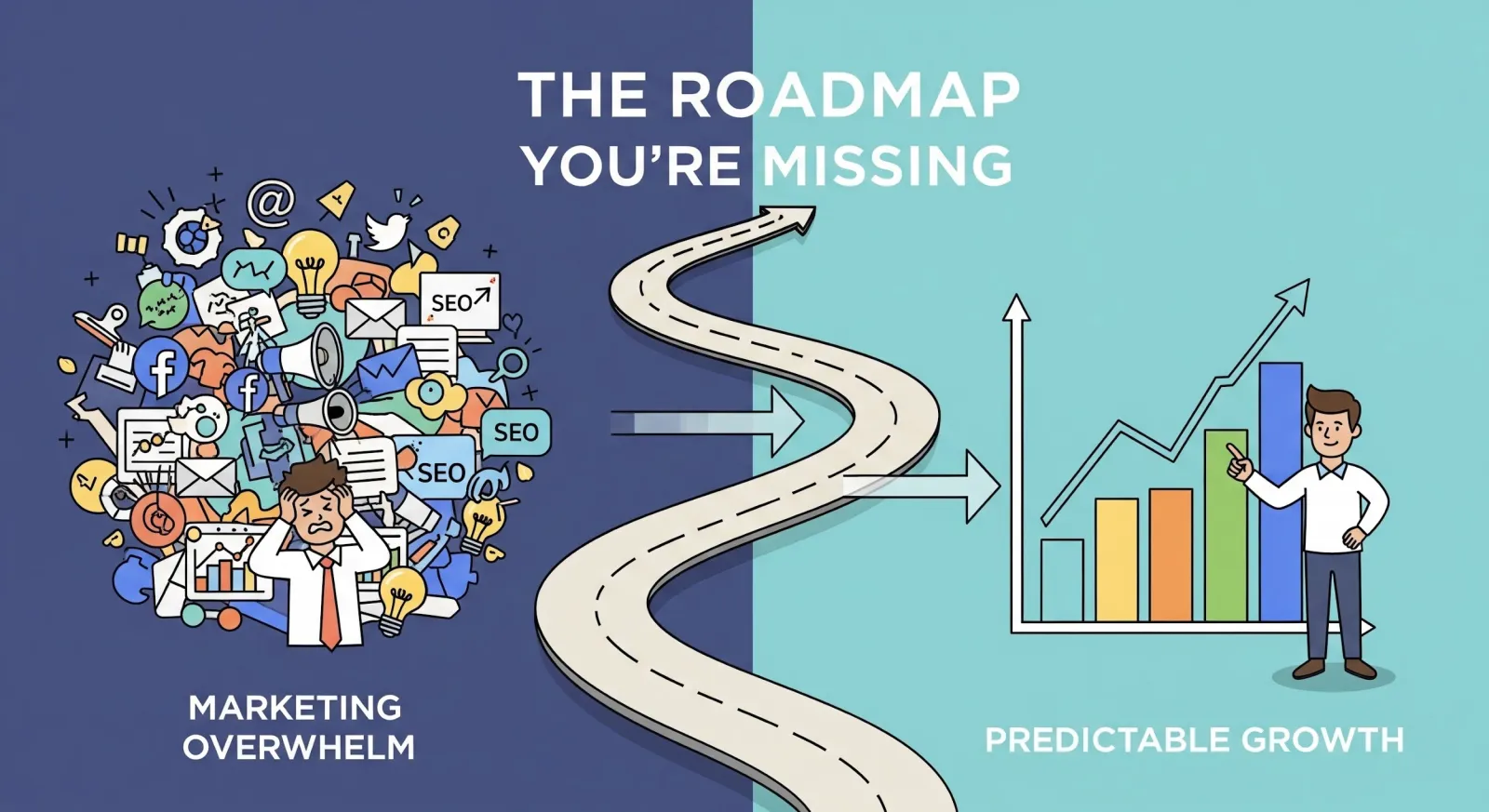
Did you know that 70% of small businesses feel overwhelmed by their marketing efforts? Are you constantly juggling social media, email campaigns, SEO, and paid ads, only to see inconsistent results?
Imagine a world where your marketing generates a steady stream of leads and sales, not just stress. This isn’t a pipe dream; it’s the predictable growth roadmap waiting to be discovered. This comprehensive guide will unveil the missing roadmap, designed specifically for you.
Get Found, Get Chosen, Get Your Time Back
A free one-day marketing seminar in Milton Keynes · 13 January 2027
For many small business owners and beginner marketers, the digital landscape feels like a never-ending labyrinth. Every day brings a new tactic, a new platform, or a new “must-do” strategy. This constant barrage leads to marketing overwhelm, a state where action paralysis replaces progress, and efforts feel fragmented and ineffective.
Get your free Marketing Action PlanNot sure where to start? Answer a few questions and get your plan in about a minute. No email needed.
Get my plan →But what if there was a clear, actionable path to transform this chaos into consistent, predictable growth? This guide will help you navigate the complexities of modern marketing with confidence and achieve sustainable results. We will break down barriers that prevent small businesses from thriving online and provide a structured approach to ensure your marketing efforts genuinely move the needle.
Understanding the Marketing Overwhelm Epidemic
The Endless Marketing To-Do List
The sheer volume of tasks under the umbrella of “digital marketing” can be staggering. From writing engaging blog posts for SEO, to managing daily social media updates, crafting compelling email newsletters, experimenting with paid advertising, and then meticulously analyzing all the data—it’s a full-time job.
Many small business owners wear multiple hats, often dedicating evenings and weekends to tasks they don’t fully understand. This creates a constant feeling of never catching up, a relentless pursuit of the next “best” strategy, and ultimately, burnout. The digital marketing challenges faced by small businesses are unique, often compounded by limited resources and a lack of specialized marketing teams. It’s easy to get lost when every platform demands attention.
Why Most Efforts Fall Flat
The primary reason why many marketing efforts by small businesses fall flat is a fundamental lack of coherent marketing strategy. Instead of building a solid foundation, businesses often jump from one tactic to another, succumbing to “shiny object syndrome.” One week it’s Instagram Reels, the next it’s TikTok, followed by a fleeting attempt at Google Ads—all without a clear understanding of how these pieces fit into a larger puzzle.
This inconsistent execution means efforts are fragmented, messages are muddled, and ultimately, no single strategy is given enough time or focus to yield meaningful results. The result is often ineffective marketing and a significant amount of wasted marketing budget, leading to frustration and a reinforcement of the feeling of overwhelm. Without a strategic framework, your marketing becomes a series of disconnected experiments rather than a deliberate path to growth.
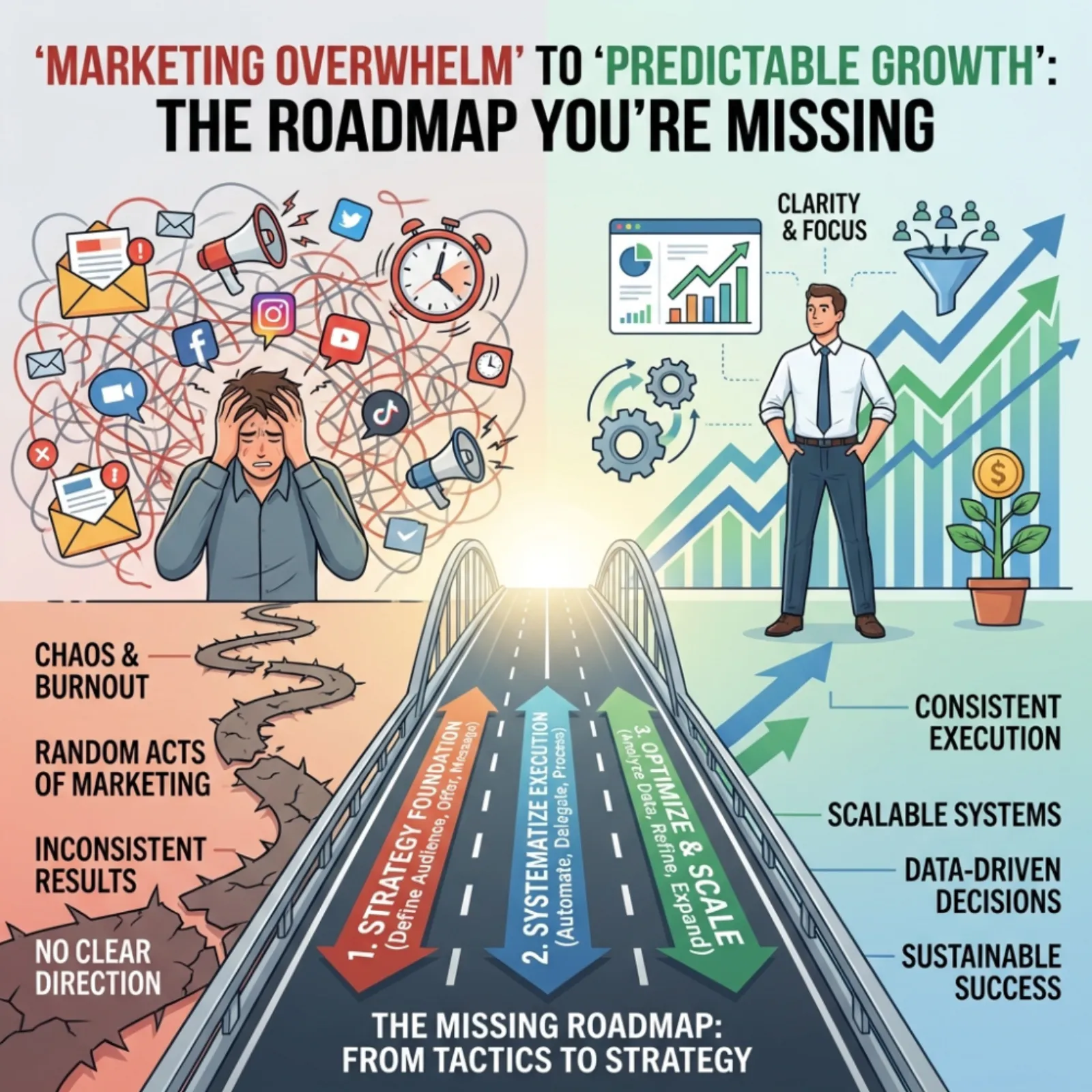
The Core Problem: Lack of a Clear Roadmap
Without a Blueprint, You’re Just Building Blindly
Imagine trying to build a house without any blueprints. You might start laying bricks, putting up walls, but without a plan, the structure would likely be unstable, inefficient, and eventually collapse. The same principle applies to your marketing. Without a clear marketing plan or a defined business growth roadmap, you’re essentially building your marketing efforts blindly.
You might be creating content, running ads, or posting on social media, but if these actions aren’t guided by a strategic blueprint, they lack direction, purpose, and ultimately, impact. A roadmap provides clarity, sets expectations, and ensures every marketing activity is intentionally moving you closer to your business goals. It’s the difference between random acts of marketing and a purposeful, strategic marketing approach.
The Impact on Small Business Owners
The absence of a clear marketing roadmap has profound and detrimental impacts on small business owners. Firstly, it’s a massive time drain. Precious hours are spent researching, implementing, and troubleshooting marketing tactics that may or may not work. Secondly, it leads to significant financial loss.
Without a clear strategy, marketing budgets, no matter how small, can be easily wasted on inefficient campaigns or platforms that don’t reach the target audience. Thirdly, it fuels marketing frustration and can lead to severe burnout. The constant pressure to perform, coupled with inconsistent results, erodes motivation.
Finally, and most critically, it results in missed opportunities for growth and threatens business sustainability. A business that cannot reliably acquire new customers and retain existing ones will struggle to scale and thrive in the long run. Predictable growth is not just about profit; it’s about peace of mind.
Shifting from Chaos to Clarity: The Predictable Growth Framework
Introducing the 3 Pillars of Predictable Growth
To transform marketing overwhelm into predictable growth, we introduce a robust framework built upon three interconnected pillars. Think of these as the foundational elements that will stabilize and elevate your marketing efforts.
The first pillar is Strategic Foundation & Audience Deep Dive, which is all about understanding who you’re talking to and why you exist. The second pillar is Streamlined Content & Channel Focus, concentrating on creating valuable content and distributing it effectively where your audience spends their time.
The third pillar is Data-Driven Optimization & Automation, ensuring your efforts are constantly improving and repetitive tasks are handled efficiently. This predictable growth framework is designed to bring marketing clarity and marketing efficiency to businesses of all sizes, making complex processes manageable and repeatable.
How This Framework Aligns with Your Business Goals
Each pillar of the predictable growth framework is meticulously designed to align directly with your overarching business goals, whether it’s increasing sales, generating more leads, improving brand awareness, or enhancing customer loyalty. The Strategic Foundation ensures that every marketing message resonates with your ideal customer, leading to higher quality leads and more efficient customer acquisition.
Streamlined Content and Channel Focus guarantees that your resources are allocated to the most impactful activities, optimizing your lead generation strategy and customer engagement. Finally, Data-Driven Optimization and Automation provide the insights and tools necessary to scale your efforts, reduce costs, and continuously improve your marketing ROI.
This holistic approach ensures that every marketing action serves a specific purpose, contributing to a unified strategy for sustainable customer acquisition and retention, ultimately driving the growth you desire.
Pillar 1: Strategic Foundation & Audience Deep Dive
Defining Your Ideal Customer with Precision
The very first step on your roadmap to predictable growth is to stop guessing and start truly understanding your ideal customer. This goes beyond basic demographics.
You need to create detailed buyer personas that encapsulate their pain points, their deepest desires, their daily challenges, where they seek information online, and what truly motivates their purchasing decisions.
For a local coffee shop, this might mean understanding not just their age group, but why they choose your coffee over a competitor’s, what time of day they visit, and what their preferred work environment looks like.
The more precise you are in defining your target audience, the more effectively you can tailor your marketing messages, product offerings, and customer experience. This precision is the bedrock upon which all successful marketing is built.
Crafting a Unique Value Proposition (UVP)
Once you understand your ideal customer, the next crucial step is to clearly articulate why should customers choose you? This is your Unique Value Proposition (UVP).
It’s not just a catchy slogan; it’s a concise statement that clearly communicates the specific benefits your business offers, how you solve your customers’ problems, and what makes you distinctly better than the competition.
For instance, a small online clothing boutique might emphasize “Ethically Sourced, Sustainable Fashion Delivered to Your Door,” highlighting both a product benefit and an ethical stance.
Your UVP becomes the core of your brand messaging, guiding all your marketing communications and helping you establish a strong competitive advantage. It answers the fundamental question: “What problem do you solve uniquely?” and sets the stage for attracting customers who truly value what you offer.
Setting SMART Marketing Objectives
With a clear understanding of your audience and your unique offering, it’s time to set SMART marketing objectives. SMART stands for Specific, Measurable, Achievable, Relevant, and Time-bound. Vague goals like “get more customers” are not helpful.
Instead, aim for something like: “Increase qualified leads by 20% through our website contact form within the next six months.” This goal is specific (qualified leads, website contact form), measurable (20%), achievable (realistic increase), relevant (directly impacts growth), and time-bound (six months).
By defining clear marketing objectives, you provide a tangible target for your efforts, making it easier to track progress and adjust your strategy as needed. This proactive approach to marketing strategy development ensures every action has a purpose and contributes directly to your desired outcomes.

Pillar 2: Streamlined Content & Channel Focus
Content that Converts, Not Just Exists
In the digital age, everyone is creating content, but not all content is created equal. To achieve predictable growth, your focus must shift from simply “creating content” to content that converts. This means producing value-driven content that directly addresses the pain points, questions, and aspirations of your buyer personas.
Instead of just talking about your products, create blog posts, videos, guides, or infographics that educate, inspire, or solve a specific problem for your audience. For example, a plumbing service might create a guide on “5 Ways to Prevent Costly Pipe Bursts This Winter,” positioning themselves as a helpful resource.
This approach to content marketing strategy builds trust, establishes authority, and naturally guides your audience through the customer journey, making your content a powerful lead nurturing content asset rather than just digital noise.
Choosing the Right Channels (And Saying No to Others)
One of the biggest traps in marketing overwhelm is the belief that you must be present on every single social media platform and every marketing channel. This is simply not true, especially for small businesses with limited resources.
The key to predictable growth lies in choosing the right channels where your ideal audience is most active and receptive to your message, and confidently saying no to others. If your audience consists primarily of busy professionals, LinkedIn and email marketing might be more effective than TikTok.
If you run a visual brand targeting a younger demographic, Instagram or Pinterest could be your powerhouse. Focus your energy on 1-3 core marketing channels where you can create a strong, consistent presence. This targeted social media strategy and email marketing approach ensures maximum impact with minimum wasted effort, leading to more efficient customer engagement and acquisition.
 LIVE
Live every Tuesday at 2pm UK. Bring your marketing questions.
Get your Google, local SEO and AI questions answered live.
The Power of a Content Calendar
Once you’ve defined your content and chosen your channels, the next actionable tip for reducing overwhelm and ensuring consistency is to implement a content calendar. A content calendar is a scheduled plan for when and where you will publish your content.
It might seem like an extra step, but it drastically reduces stress, ensures a consistent flow of valuable content, and allows you to strategically align your content with your overall marketing planning and objectives. Imagine knowing exactly what blog post, social media update, or email newsletter is going out each week for the next month.
This proactive approach prevents last-minute scrambling, ensures your messages are timely and relevant, and provides the necessary framework for consistent marketing. Tools for content calendars can range from a simple spreadsheet to dedicated project management software, making it accessible for any budget.
Pillar 3: Data-Driven Optimization & Automation
Decoding Your Marketing Performance with Analytics
The third pillar for predictable growth is rooted in understanding and responding to data. This means moving beyond “hope marketing” and truly decoding your marketing performance with analytics. Instead of just looking at vanity metrics like total likes or followers, focus on key performance indicators (KPIs) that directly impact your business goals. These might include conversion rates, cost per lead (CPL), customer lifetime value (CLTV), or website traffic sources that lead to sales.
Tools like Google Analytics can provide invaluable insights into user behavior, helping you understand what’s working and what isn’t. By making data-driven decisions, you eliminate guesswork and ensure your marketing budget is spent on strategies that deliver a measurable marketing ROI. This iterative process of analysis and adjustment is critical for continuous improvement and sustainable growth.
Automating Repetitive Tasks for Efficiency
One of the most significant contributors to marketing overwhelm is the sheer volume of repetitive tasks. The good news is that many of these can be automated, freeing up your valuable time for strategic thinking and relationship building.
Marketing automation involves using software to automate repetitive marketing activities like email sequences, social media scheduling, lead nurturing, and even personalized communication. For example, setting up an automated email series to welcome new subscribers, or using a scheduling tool to pre-plan your social media posts for the week.
Implementing automation tools, even simple ones, can dramatically increase your marketing efficiency and free up hours each week. There are many affordable small business tools available that can handle these tasks, allowing you to focus on the human elements of your business.
Continuous Improvement: The Iterative Loop
The journey to predictable growth is not a one-time setup; it’s a dynamic and ongoing process of continuous improvement. Your marketing roadmap should involve an iterative loop: test, measure, learn, and adapt. The digital landscape is constantly evolving, and what works today might need refinement tomorrow.
This means regularly reviewing your analytics, running A/B tests on your headlines, ad copy, or landing pages, and being willing to adapt your strategies based on performance data. Embrace marketing optimization as an integral part of your process.
This iterative approach allows you to constantly refine your tactics, improve your results, and stay ahead of the curve. Remember, marketing is never truly “done”; it’s a continuous journey of learning and refinement that builds resilience and ensures long-term success.
Real-World Transformation: Case Studies of Predictable Growth
The Local Bakery’s Digital Dough
Consider “The Daily Crumb,” a beloved local bakery that was struggling with inconsistent foot traffic despite having delicious products. Their social media was sporadic, and they had no clear plan for attracting new customers online. The owner felt constant marketing overwhelm.
By implementing the predictable growth roadmap, they first defined their ideal customer: local families and office workers looking for quality baked goods. They then focused on local SEO, optimizing their Google My Business profile and encouraging customer reviews. Their content strategy shifted to showcasing daily specials, behind-the-scenes baking, and customer testimonials.
An email marketing success story emerged as they started collecting emails for a weekly newsletter offering discounts and new product alerts. The result? A significant increase in consistent foot traffic, a growing online order business, and a predictable stream of “digital dough” supplementing their traditional sales. This small business case study demonstrates the power of a focused digital strategy.
The Consulting Firm’s Client Cadence
Next, let’s look at “Strategic Edge Consulting,” a B2B firm whose founder was overwhelmed by the feast-or-famine cycle of client acquisition. Leads were inconsistent, and much of their time was spent chasing new business rather than serving existing clients.
Adopting the predictable growth framework, they refined their ideal client persona to mid-sized manufacturing companies needing operational efficiency. They then built a robust content marketing for consultants strategy, publishing expert articles, whitepapers, and webinars addressing their target audience’s specific challenges.
They implemented marketing automation to nurture leads who downloaded their resources, sending personalized email sequences over several weeks. This consistent and value-driven approach resulted in a steady, predictable stream of qualified leads, transforming their B2B marketing efforts. The firm now enjoys a consistent lead generation case study success, allowing them to focus on delivering exceptional service rather than constantly scrambling for new opportunities.
Overcoming Common Roadblocks on Your Journey
Battling Budget Constraints
For many small business owners, marketing budget constraints are a significant hurdle. However, predictable growth does not necessarily equate to expensive marketing. There are numerous strategies to maximize limited budgets. Focus heavily on organic growth strategies such as SEO and content marketing, which yield long-term benefits without high ad spend.
Repurpose your content across multiple platforms to get more mileage from each piece. Utilize affordable marketing and free tools for social media scheduling, email marketing, and basic analytics. Engaging with your community online and offline can also generate buzz at little to no cost.
The key is to be resourceful and strategic, prioritizing tactics that offer the best return on investment for your specific business. Don’t let a small budget deter you; instead, let it inspire creativity in your approach to free marketing tools and strategies.
Finding the Right Tools and Technologies
The sheer number of marketing tools and technologies available can be another source of overwhelm. The trick is to start small and scale as your needs grow. Don’t feel pressured to invest in every cutting-edge software immediately.
Begin with essential marketing tools that address your most pressing needs, such as a reliable email marketing platform, a social media scheduler, and a basic CRM for small business to manage customer relationships. Look for scalable solutions that can grow with you.
Before committing, take advantage of free trials to test if a tool genuinely fits your workflow. Prioritize based on what will save you the most time or provide the most critical insights, rather than just what’s popular. A streamlined technology stack with a few powerful tools that you actually use effectively is far better than a dozen unused subscriptions.
Staying Motivated and Consistent
The journey from marketing overwhelm to predictable growth is a marathon, not a sprint. It requires dedication, patience, and marketing consistency. It’s easy to lose motivation when results aren’t immediate, but remember that foundational work often takes time to show significant returns.
Celebrate small wins along the way—a new subscriber, a positive customer review, a slight increase in website traffic—as these are indicators of progress. Seek support from fellow small business owners, join online communities, or consider a mentor.
Having a support system can provide encouragement and fresh perspectives during challenging times. Remind yourself of your long-term vision and the impact predictable growth will have on your business and your life. This dedication to a long-term marketing strategy is crucial for overcoming plateaus and maintaining the momentum necessary for sustained business motivation and growth.
Frequently Asked Questions (FAQ)
How quickly can I see results with a predictable growth roadmap?
While immediate results are possible, consistent and significant growth typically takes 3-6 months. It’s important to remember that this is a marathon, not a sprint. The foundational work in defining your audience and strategy lays the groundwork for sustainable, long-term success, and these efforts compound over time. Patience and consistency are key.
Is this framework only for online businesses?
No, this framework applies to any business, regardless of whether you operate purely online or have a physical location. Even brick-and-mortar stores benefit immensely from a strong online presence, targeted local marketing, and a clear strategy for attracting and retaining customers. The principles of understanding your audience and delivering value are universal.
What’s the most important first step if I’m completely overwhelmed?
If you’re feeling completely overwhelmed, the most important first step is to focus on Pillar 1: Strategic Foundation. Start by clearly defining your ideal customer and articulating your unique value proposition. Achieving clarity here will inform every subsequent marketing decision, making the entire process less daunting and far more effective.
How can a small business compete with larger companies using this roadmap?
A predictable growth roadmap helps small businesses compete by enabling them to be strategic and efficient. Focus on niche audiences where larger companies may not specialize, offer superior, personalized customer service, and leverage authentic brand storytelling. Your agility and ability to connect deeply with specific customer segments can be a powerful competitive advantage.
Do I need expensive software for marketing automation?
Not necessarily. While advanced software exists, many affordable or even free tools can get you started with marketing automation. Begin by identifying your most time-consuming, repetitive tasks, then research tools that specifically address those needs without breaking your budget. You can always upgrade and expand your toolkit as your business grows and your needs evolve.
Final Thoughts and Your Next Steps
The journey from marketing overwhelm to predictable growth is a transformative one. It shifts your perspective from seeing marketing as a burdensome chore to viewing it as a powerful, controllable engine for your business.
By embracing a clear roadmap, built on strategic foundations, streamlined execution, and data-driven insights, you empower yourself to make informed decisions, optimize your efforts, and achieve sustainable success.
This framework is not just about growing your business; it’s about reducing stress, increasing confidence, and giving you the clarity to truly enjoy the entrepreneurial journey. This is your path to marketing empowerment and ultimately, long-term business transformation.
The time for fragmented, reactive marketing is over. It’s time to take control and chart your course toward predictable, consistent growth. Don’t let another day pass in the shadow of marketing overwhelm.
Your next step is to choose one aspect of the predictable growth roadmap and start implementing it today. Perhaps it’s carving out an hour to define your ideal customer with more precision, or maybe it’s scheduling your content for the next two weeks.
Take a concrete step, no matter how small, and commit to the process. For additional resources and templates to kickstart your journey, visit our website and download your free marketing action plan guide. Start your growth journey now and unlock the predictable success your business deserves.

Written by Uzair Kharawala
Partner at SF Digital Studios, a Google Premier Partner agency. Uzair has been helping businesses grow with Google Ads since 2002 and teaches it every week on YouTube.
Get our best Google Ads tips by email
New articles and videos, straight to your inbox. Unsubscribe any time.